
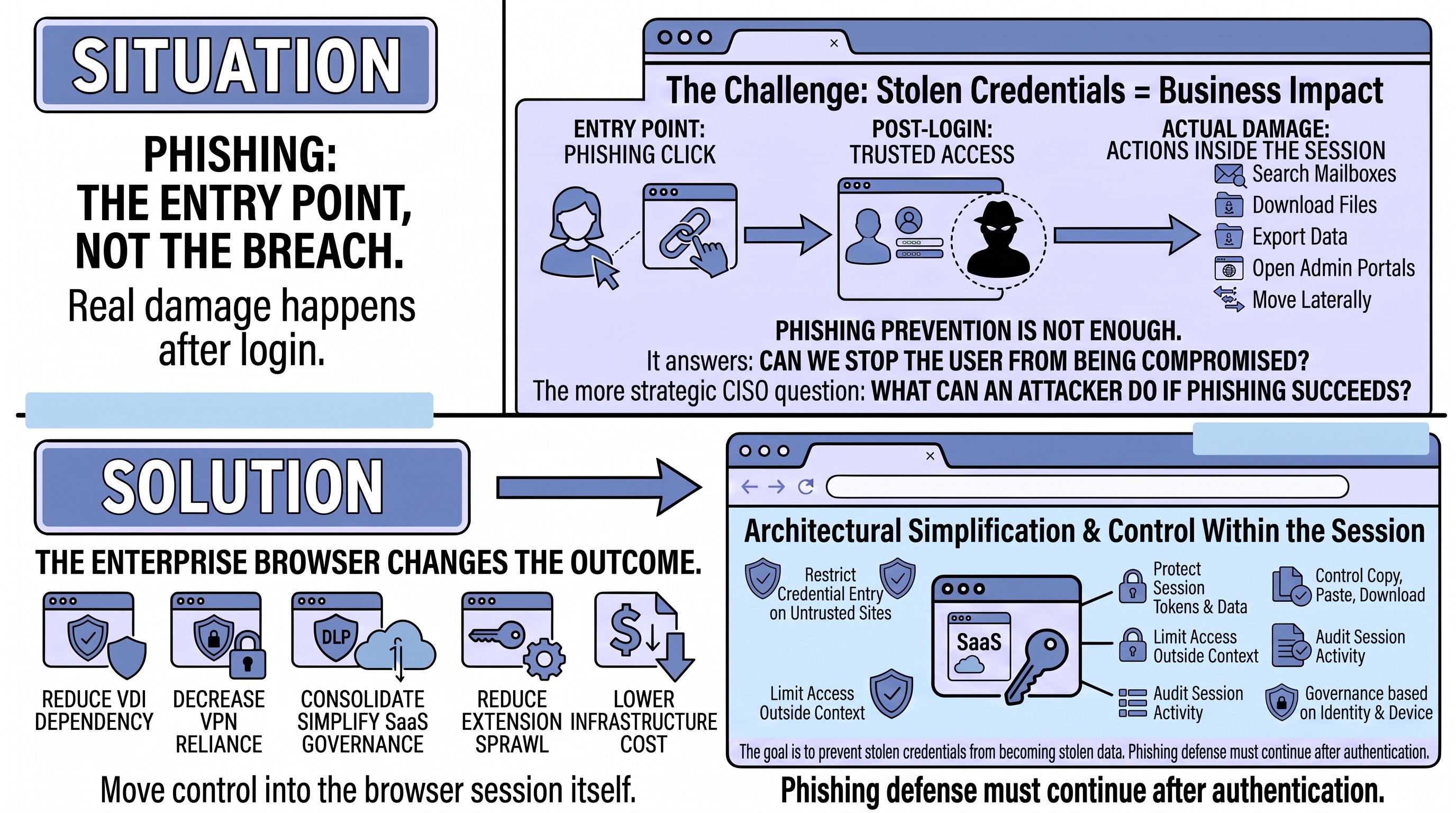
Phishing steals access. Session security helps prevent stolen credentials from becoming stolen data.

Most companies focus on stopping phishing before the user clicks.
That is necessary.
But it is incomplete.
The more strategic CISO question is not only:
Can we stop phishing?
It is also:
What can an attacker do if phishing succeeds?
1. Why phishing remains a board-level concern
Phishing remains one of the most feared attack types because it does not require advanced exploitation. It manipulates people into giving away access. Today,that access can include passwords, MFA codes, OAuth consent, cookies, or session tokens.
The attacker’s goal is not the click.
The goal is trusted access.
2. Whatcompanies already do to prevent phishing
Most organizations already have layered defenses:
E-mail filtering.
Threat intelligence.
User awareness training.
Phishing simulations.
MFA.
Conditional access.
SPF, DKIM, and DMARC.
Password managers.
Endpoint detection.
Incident response.
These controls are important.
But they mainly focus on preventing the attack from succeeding.
3. Why prevention alone is not enough
No phishing program is perfect.
Attackers use trusted brands, compromised suppliers, QR codes, fake login pages, AI-generated messages, and social engineering. Some phishing attacks do not even need the user’s password if they can capture a session token or manipulate authentication flows.
That means organizations need to assume that some credentials will eventually be compromised.
4. How stolen credentials become stolen data
Once attackers have valid credentials or session access, they can operate inside legitimate applications.
They can search mailboxes.
Download files.
Access SaaS systems.
Export customer data.
Copy sensitive information.
Create forwarding rules.
Use cloud storage.
Access admin portals.
Move laterally.
Abuse trusted sessions.
To the application, the attacker may look like the real user.
That is why login security is not the same as session security.
5. The missing control layer
Identity controls answer:
Who is the user?
Network controls answer:
Where is the user going?
Endpoint controls answer:
Is the device compromised?
But phishing exploitation often requires another question:
What is the user allowed to do inside the session?
That is where browser-level governance becomes highly relevant.
6. How the enterprise browser changes the outcome
It helps enforce controls inside the browser session.
It can restrict credential entry on un-trusted sites.
Protect session tokens and local browser data.
Limit use of stolen credentials outside approved context.
Control access from managed and unmanaged devices.
Restrict copy, paste, download, upload, print, and screenshot activity.
Govern browser extensions.
Apply policy based on identity, device, app, role, and risk.
Create auditability around browser-based work.
This means a stolen credential does not automatically equal unrestricted access.
And access does not automatically equal data loss.
7. Strategic conclusion
Phishing prevention is still essential.
But the modern security model must go further.
The goal is not only to stop the user from entering credentials into the wrong place.
The goal is to make stolen credentials less useful.
That requires control after authentication.
Inside the session.
Where the data is viewed.
Where it is copied.
Where it is downloaded.
Where it is shared.
Where it is submitted to AI.
Where attackers try to turn access into impact.
Do not only ask how well you prevent phishing.
Ask what stolen credentials can actually do in your environment.
CySecPros helps organizations evaluate how the enterprise browser can reduce the impact of phishing by controlling access, sessions, data movement, and browser-based work after authentication.
Strengthen your session and control framework - contact CySecPros for a confidential discussion.
.svg)