
Authentication verifies entry; session security controls what users, data, extensions, and AI do next.
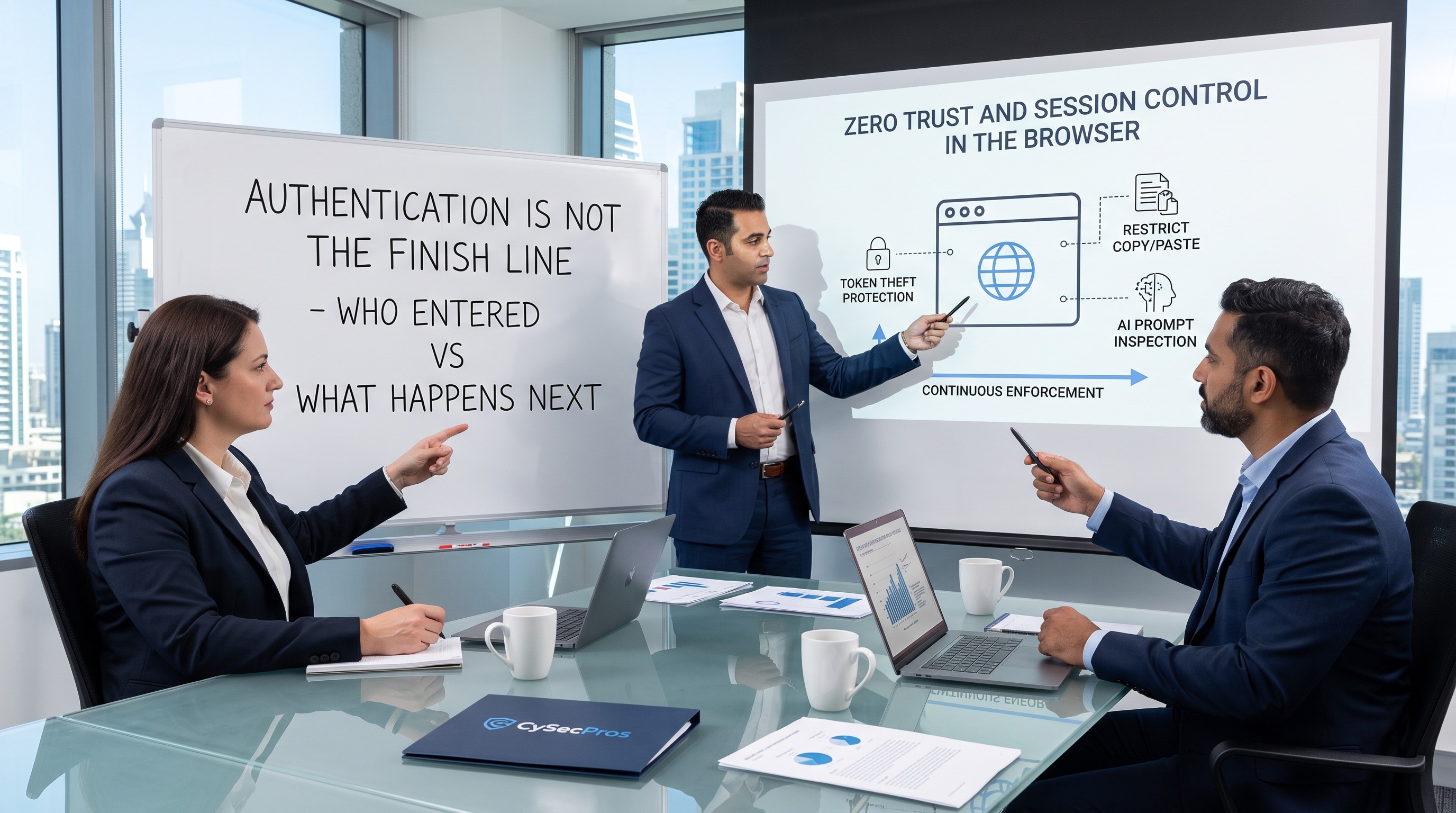
Authentication tells you who entered.
It does not tell you what happens next.
That distinction is becoming one of the most important security questions for CISOs and CIOs.
For years,the enterprise security model has focused heavily on the moment of access.
Who is the user?
Is MFA enabled?
Is the device compliant?
Is the login suspicious?
Should the user be allowed in?
Those questions still matter.
But they are no longer enough.
Because many modern attacks do not fail at authentication.
They begin after authentication succeeds.
A user logs in legitimately.
MFA is approved.
The identity provider does its job.
The SaaS session is established.
Then the real risk begins.
A session token is stolen.
A malicious browser extension observes activity.
Sensitive data is copied into an unmanaged AI tool.
A contractor downloads files locally.
Credentials are entered into a convincing phishing page.
A privileged user performs risky actions inside an admin console.
From the identity layer, everything may still look clean.
No failed login.
No impossible travel.
No brute force attempt.
No obvious MFA bypass.
The user entered through the front door.
But who is controlling the room?
Post-authentication is the real attack surface
The modern enterprise runs in the browser.
Email.
CRM.
Finance systems.
HR platforms.
Cloud consoles.
Internal applications.
AI tools.
The browser is no longer just a way to view applications.
It is the operating layer of modern work.
Yet many security architectures still treat authentication as the main trust decision.
Once access is granted, the session is often assumed to be safe.
That assumption is dangerous.
Zero trust should not end after authentication.
A true zero trust model must continue into the active session, where users interact with applications, data, AI services, and third parties.
Identity tells you who entered.
Session security helps you control what happens next.
What traditional controls often miss
Network tools can inspect traffic.
Identity tools can validate users.
Endpoint tools can monitor devices.
But many critical risks happen at the interaction layer.
Can the user copy sensitive content?
Can they paste it into an external AI tool?
Can they download customer data to an unmanaged device?
Can a browser extension access session content?
Can a stolen token be reused outside the managed environment?
Can credentials be submitted to an unapproved domain?
These are not only network questions.
They are session questions.
And session questions require controls inside the browser itself.
Why the browser changes the security model
An enterprise browser moves enforcement to the place where work happens.
Inside the session.
That makes it possible to apply context-aware controls based on identity, device posture, application, tenant, role, location, data sensitivity, and user behavior.
Instead of only deciding whether someone gets access, the organization can govern what they are allowed to do after access is granted.
This includes controlling downloads, uploads, copy, paste, printing, screenshots, credential entry, browser extensions, AI prompts, and session behavior.
It also enables stronger protection against token theft and session replay by binding access to the managed browser environment and limiting what can happen outside approved context.
That is a major architectural shift.
Security is no longer only around the browser.
Security is in the browser.
AI makes his urgent
AI has increased the importance of session-level governance.
Employees use AI tools to summarize documents, draft contracts, analyze data, support customers, and automate work.
The issue is not AI adoption.
The issue is uncontrolled AI interaction.
A user can paste sensitive data into a prompt before traditional tools understand what happened.
- An AI extension can interact with browser content.
- An AI agent an access systems and act at speed.
If AI governance happens only at the network layer, it will miss critical context.
Session-level control makes it possible to inspect prompts, distinguish corporate and personal tenants, restrict unsanctioned tools, and protect sensitive data before it leaves the browser session.
That is where AI governance becomes practical.
The CISO question
The strategic question is not whether your identity provider works.
It probably does.
The question is what happens after it works.
- Can you control the session?
- Can you see user interaction?
- Can you stop sensitive data movement?
- Can you restrict risky extensions?
- Can you prevent credential entry on un-trusted domains?
- Can you contain token theft?
- Can you govern AI usage in real time?
If the answer is unclear, authentication may be giving a false sense of control.
Authentication is the start of trust verification.
It should not be the end.
A better model
The next generation of enterprise security must combine identity with session enforcement.
Identity confirms who entered.
The enterprise browser controls what happens next.
- That is how zero trust becomes continuous.
- That is how SaaS security becomes practical.
- That is how AI governance becomes enforceable.
- And that is how organizations move from access control to actual control.
CySecPros helps organizations evaluate how enterprise browser architecture can strengthen session security, reduce post-authentication risk, and modernize controls where work actually happens.
If you are reviewing your zero trust, SaaS, AI, or identity security strategy, contact CySecPros for a confidential session-level security assessment.
Strengthen your session and control framework - contact CySecPros for a confidential discussion.
.svg)