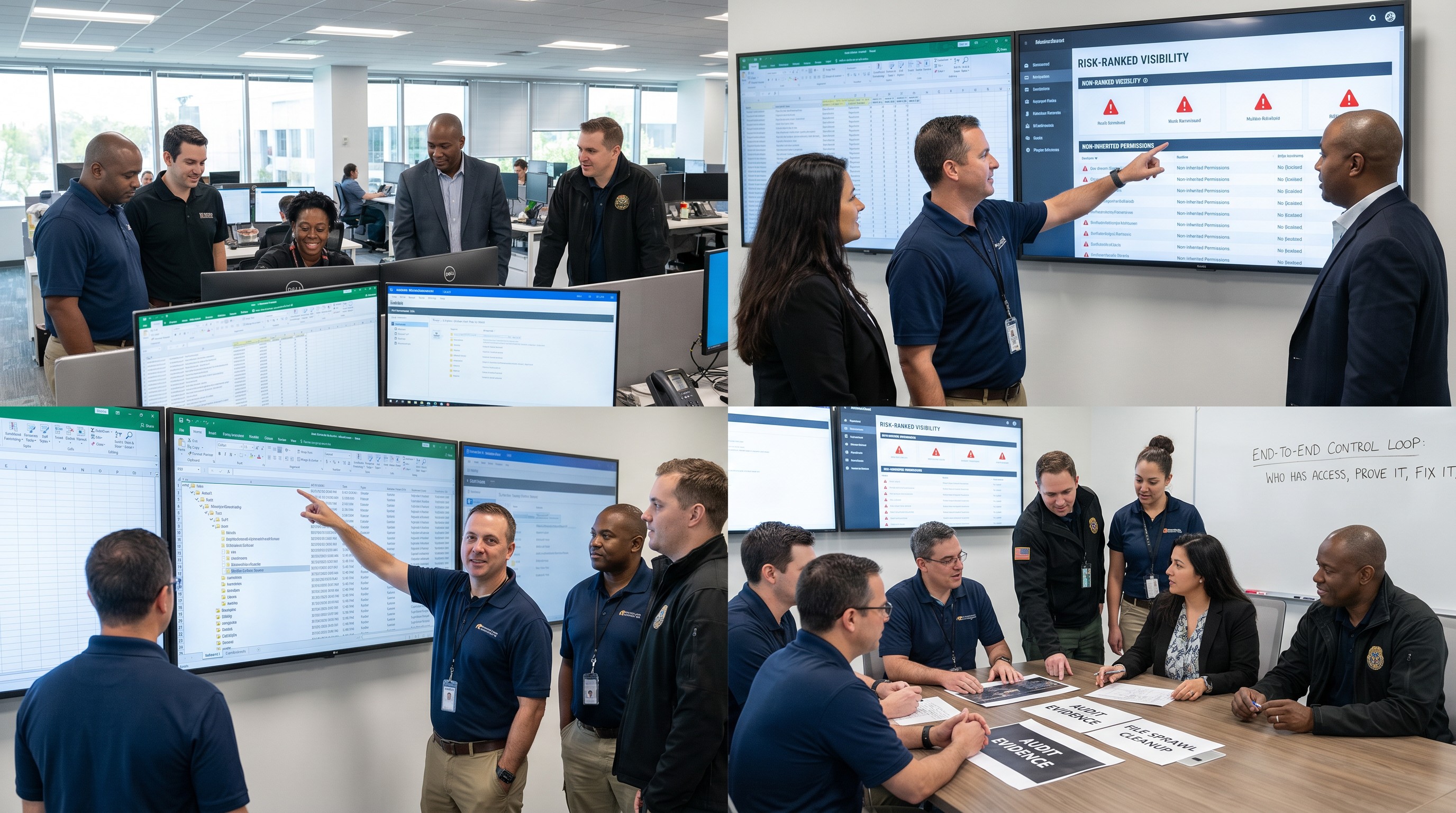
Configuration drift quietly weakens Microsoft 365 security. Learn how continuous governance strengthens cyber resilience.

Security teams spend enormous effort protecting Microsoft 365 from external threats.
Multi-factor authentication is enforced.
Conditional Access is configured.
Microsoft Defender generates alerts.
SIEM platforms collect telemetry.
SOC analysts investigate suspicious activity.
Yet one of the most common causes of increased cyber risk often receives far less attention:
Configuration drift.
Not because it is invisible.
Because it happens gradually.
Microsoft 365 is no longer a single platform.
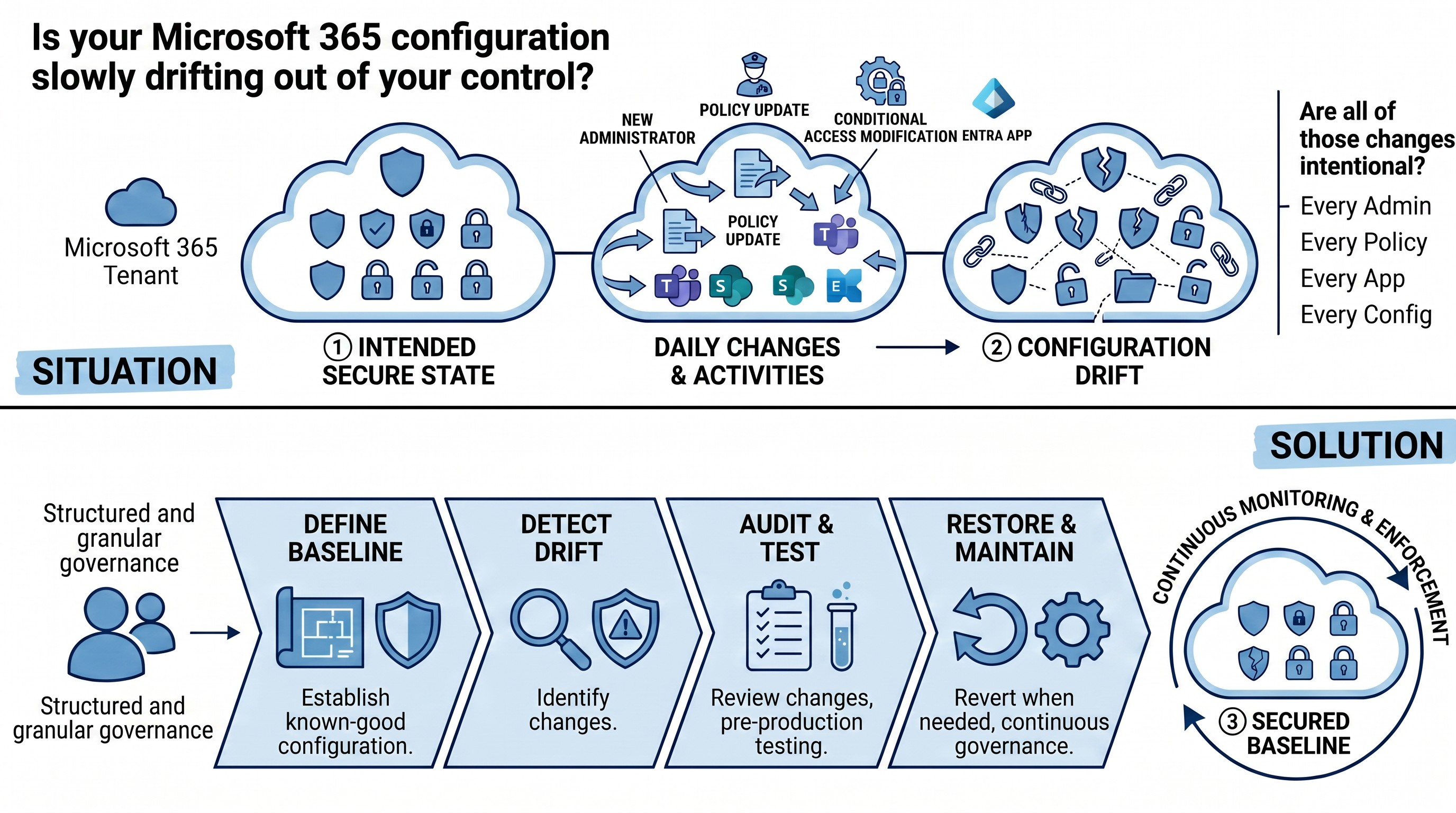
It spans Entra ID, Exchange, SharePoint, Teams, Intune, Defender, Purview and dozens of interconnected services.
Each platform evolves continuously.
Administrators create new policies.
Engineers modify Conditional Access.
Projects introduce new Teams settings.
Applications are registered in Entra ID.
Permissions are delegated.
Security exceptions are approved.
None of these activities are unusual.
The problem is cumulative change.
Months later, few organizations can confidently answer:
The issue is no longer malicious activity.
It is the gradual erosion of the intended security posture.
Attackers rarely need every control to fail.
They only need one.
A single relaxed Conditional Access policy.
An overlooked privileged role.
A forgotten application registration.
An overly permissive SharePoint configuration.
These weaknesses often appear long after a project has ended or an administrator has left.
To an attacker, configuration drift is opportunity.
To a SOC team, it creates uncertainty.
Was this configuration always like this?
Or did someone change it yesterday?
One of the first questions during an incident is surprisingly simple:
What changed?
Unfortunately, this is often the hardest question to answer.
SOC analysts may spend hours, or even days, reconstructing configuration history from audit logs spread across multiple Microsoft 365 workloads.
Even after identifying the change, new questions arise:
The longer these questions remain unanswered, the longer recovery takes.
Most organizations focus heavily on preventing unauthorized changes.
Fewer invest in making authorized changes safe.
Security leaders increasingly treat Microsoft 365 configuration the same way software teams treat source code.
Every production environment should have:
This shifts configuration management from a reactive administrative task to a core element of cyber resilience.
Every CISO hopes they never need to recover a Microsoft 365 tenant after a major incident.
Resilience, however, is measured by preparation rather than optimism.
Modern recovery extends beyond restoring mailboxes or documents.
It also includes restoring the security controls that protect them.
Identity policies.
Conditional Access.
Teams settings.
SharePoint permissions.
Defender configurations.
Exchange settings.
Intune policies.
Without confidence in these configurations, organizations may restore services while unknowingly leaving security gaps behind.
Microsoft continues to expand the capabilities of Microsoft 365.
That benefits productivity.
Every new feature introduces additional configuration options, security policies and administrative decisions. Large enterprises now manage thousands of configuration types across Microsoft 365 services and often maintain separate development, test and production tenants. Keeping these environments aligned manually becomes increasingly difficult as complexity grows.
The challenge facing CISOs is no longer simply securing Microsoft 365.
It is maintaining a secure state over time.
Configuration management is often viewed as an operational responsibility.
Increasingly, it is becoming a security capability.
Organizations that continuously measure their environment against a defined baseline, detect configuration drift, maintain complete change visibility and rapidly restore trusted configurations are significantly better positioned to withstand both human error and malicious activity. Capabilities such as configuration baselining, drift detection, change auditing, backup and restore, and consistent deployment across development, test and production environments support this more resilient operating model.
The question for security leaders is no longer:
"Is our Microsoft 365 environment secure?"
It is:
"How quickly would we know if it was no longer secure?"
Can you prove your Microsoft 365 security posture has not drifted? Let us validate it together.
Strengthen your session and control framework - contact CySecPros for a confidential discussion.
.svg)