
SharePoint oversharing silently expands your attack surface, putting security, compliance, and AI readiness at risk.
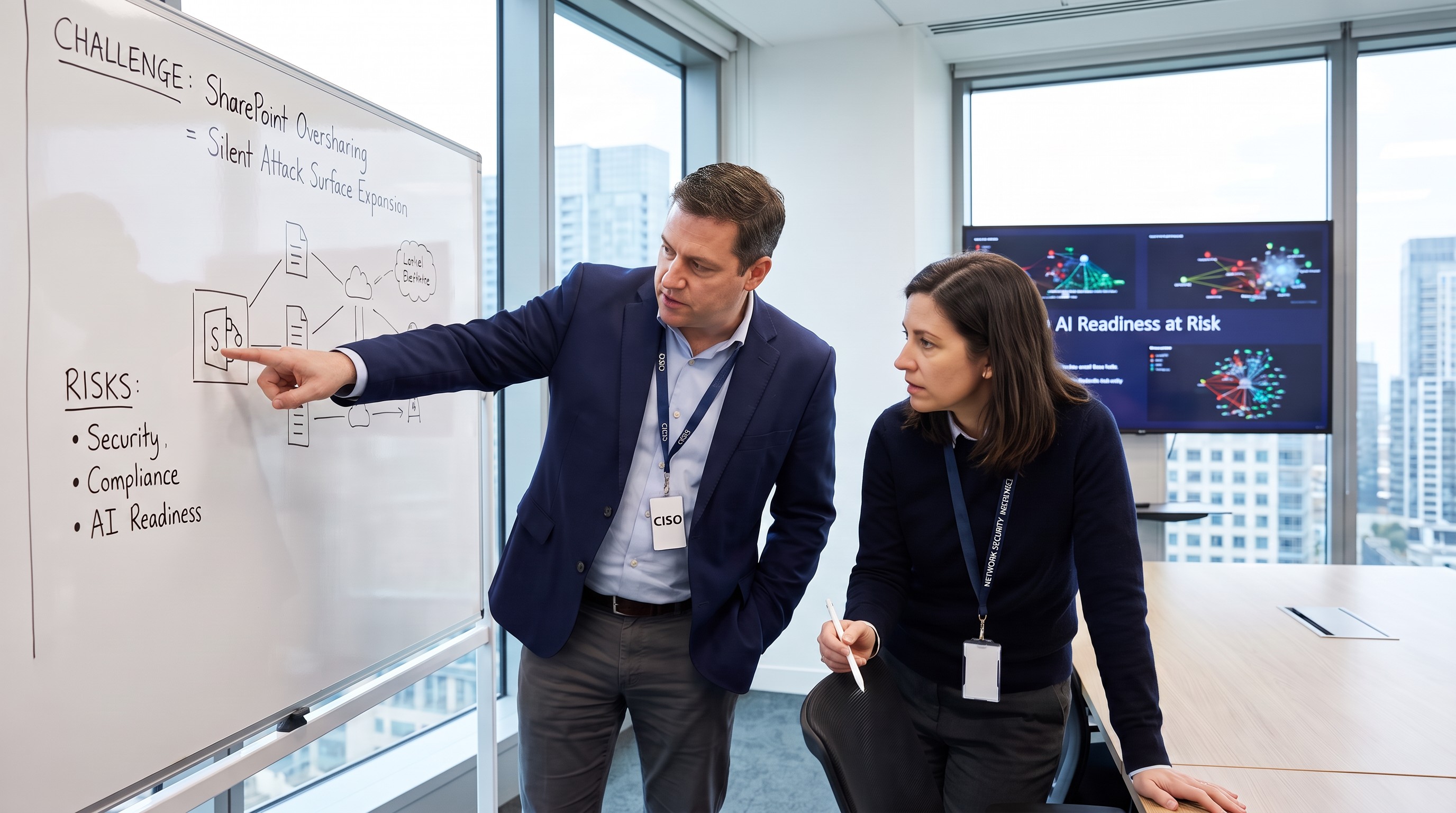
Most organizations believe they have control over their SharePoint environment.
Most do not.
The problem is not the SharePoint site.
It is the millions of files, folders, sharing links, guest accounts, and unique permissions beneath it.
Every time someone clicks Share, grants direct access, or creates an anonymous link, the organization's attack surface quietly expands. The vast majority of these actions are legitimate. Few are ever reviewed again.
Over time,SharePoint evolves into one of the largest unmanaged security risks inside Microsoft 365.
Today, AI has made that risk impossible to ignore.
The governance gap Microsoft leaves behind
Microsoft provides strong collaboration capabilities and site-level administration.
But enterprise risk has moved beyond the site boundary.
Sensitive data is increasingly protected, or exposed, through item-level permissions.Individual files and folders often have unique access rights that evolve independently of the SharePoint site itself.
For most organizations, answering questions such as these is surprisingly difficult:
Without this visibility, governance becomes reactive instead of continuous.
Why AI changes everything
Before AI, oversharing primarily represented a compliance and security concern.
Today, it also determines what AI can discover.
Microsoft Copilot and other AI services inherit the permissions already configured inside SharePoint.
They do not understand business intent.
They understand access.
If confidential information is overshared today, AI simply makes it easier to find tomorrow.
The challenge is no longer preparing for AI.
It is ensuring your SharePoint permissions are ready before AI is deployed.
Visibility alone does not reduce risk
Many organizations already know they have permission sprawl.
- They have reports.
- PowerShell scripts.
- Periodic access reviews.
- Manual investigations.
The problem is that reports do not fix oversharing.
Effective governance requires an operational control process that continuously:
Security is no longer about knowing where the risk exists.
It is about reducing it before an incident, an auditor, or an AI assistant discovers it first.
Governance should improve operations, not create more work
SharePoint governance is often treated as a compliance exercise.
In reality, it is also an operational efficiency challenge.
Security teams spend countless hours investigating permissions, preparing audit evidence, reviewing external access, cleaning up storage, and responding to governance requests.
At the same time:
Modern governance should reduce operational effort while improving security.
That means replacing manual investigations with continuous monitoring, automating policy enforcement, reclaiming unused storage, and producing audit evidence on demand instead of rebuilding it every audit cycle.
What good governance looks like
Strong SharePoint governance is not a one-time clean-up project.
It is a continuous operational process.
A proven approach includes five steps:
The objective is not simply to understand your SharePoint environment.
It is to continuously control it.
From oversharing to operational resilience
SharePoint governance is no longer just an IT responsibility.
It directly impacts cybersecurity, compliance, AI readiness, operational efficiency,storage optimization, and business resilience.
Organizations that continuously govern permissions are better prepared to:
Governance should not stop at visibility.
It should deliver measurable control.
Because the real question is no longer:
"Who owns this SharePoint site?"
It is:
"Can we confidently prove who has access to every sensitive document across our Microsoft 365 tenant?"
Concerned about SharePoint oversharing, AI readiness, or governance at scale? We are currently helping large organizations assess their SharePoint governance maturity. Contact us for a confidential 45-minute SharePoint Governance Exposure Review and identify where security, compliance, and operational efficiency can be significantly improved.
Strengthen your session and control framework - contact CySecPros for a confidential discussion.
.svg)