
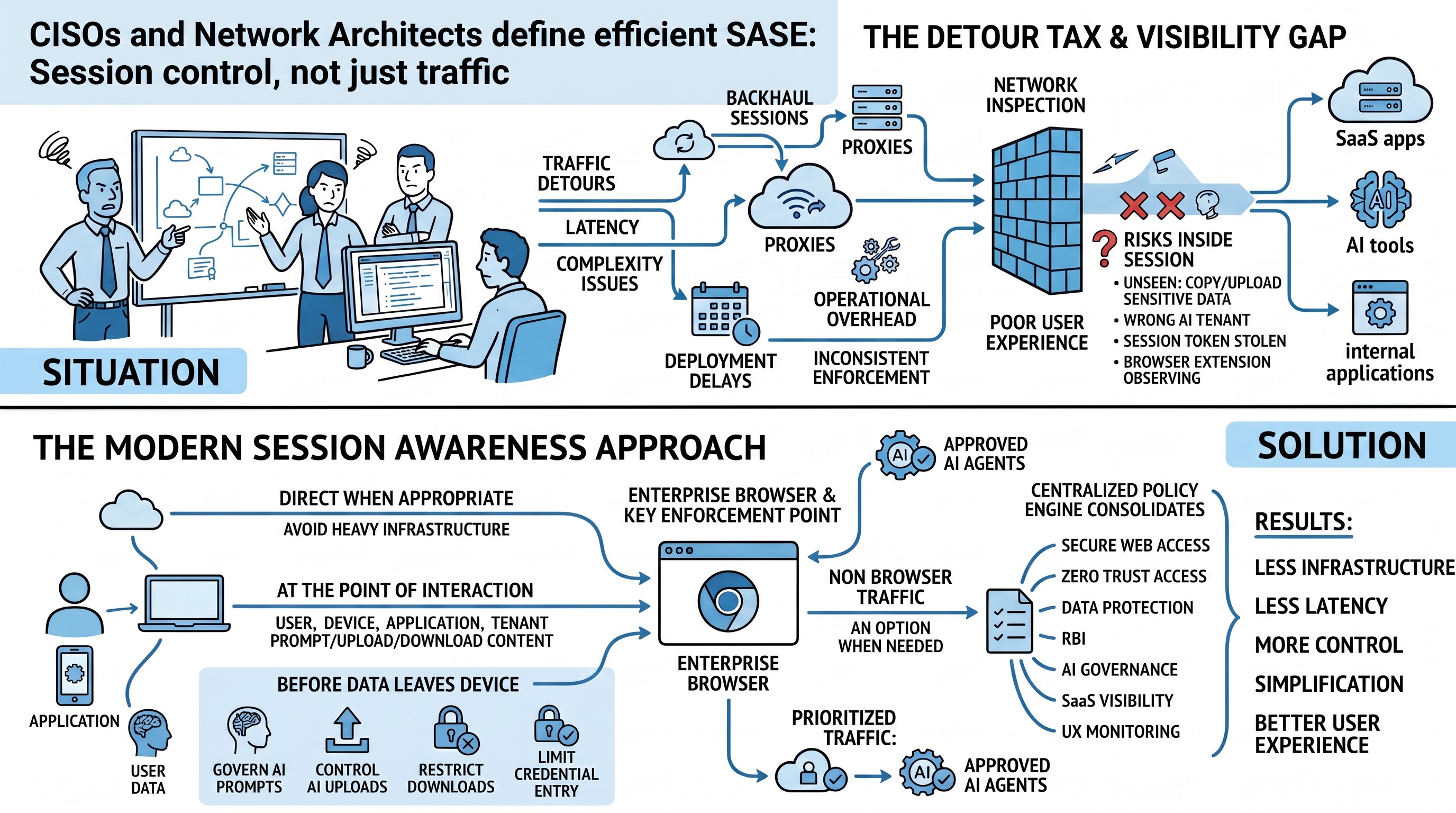
Modern SASE should reduce backhaul, complexity, and latency by moving enforcement into the browser session.

Traditional SASE solved an important problem.
It brought security closer to users.
It moved parts of the security stack into the cloud.
It helped organizations deal with remote work, SaaS adoption, and distributed access.
For many enterprises, that was a necessary step.
But the way many SASE architectures are implemented today creates a new problem.
Too much traffic is still forced through too many detours.
Too many sessions are backhauled.
Too many proxies sit between users and the applications they need.
Too much security depends on breaking, inspecting, and rerouting traffic.
The result is familiar to most CISOs and CIOs:
- Latency.
- Complexity.
- Certificate issues.
- Deployment delays.
- Operational overhead.
- Inconsistent enforcement.
- Poor user experience.
Security becomes the path to every application.
And when the security path breaks, work stops.
The detour tax
The original logic was simple.
Route traffic through inspection points.
Apply policy.
Block risk.
Send clean traffic onward.
That model worked well when applications lived in predictable places, users worked from managed networks, and most risk could be understood through traffic inspection.
That world has changed.
Work now happens in the browser.
- SaaS applications.
- AI tools.
- Cloud consoles.
- Collaboration platforms.
- Internal applications.
- Partner portals.
The risk is no longer only in the packet.
It is in the interaction.
- A user pastes sensitive data into an AI prompt.
- A contractor downloads customer data from a SaaS application.
- A session token is stolen after MFA.
- An AI agent accesses tools at machine speed.
- A browser extension observes corporate activity.
A proxy may see traffic.
But it may not understand intent.
That is the limitation of traditional SASE when applied to modern work.
The visibility gap
Traditional SASE often assumes that traffic inspection equals control.
But much of the most important risk now occurs inside authenticated sessions.
- What did the user copy?
- What did they upload?
- Which AI tenant did they use?
- Was the account corporate or personal?
- Did a browser extension interact with the session?
- Was sensitive data exposed before it left the device?
These are not simply network questions.
They are session questions.
And session questions require enforcement where the session actually happens.
At the user experience layer.
Inside the browser.
Backhaul should be the fallback, not the default
A smarter model does not send every session on a round trip through distant infrastructure simply because that is how legacy architectures were designed.
It evaluates context at the point of interaction.
- Who is the user?
- What device are they using?
- Which application are they accessing?
- What are they trying to do?
- What data is involved?
- Is AI part of the workflow?
When the traffic can go direct, it should go direct.
When inspection adds value, it should be invoked.
When the browser can enforce policy natively, backhauling becomes unnecessary.
This changes the economics and the user experience of secure access.
- Less detour.
- Less latency.
- Less infrastructure dependency.
- Less operational fragility.
A modern SASE model starts with the user
The modern approach is not to abandon SASE principles.
It is to redesign them around how people and AI agents actually work.
A modern enterprise browser can act as the enforcement point for browser based work. It can govern SaaS access, web activity, AI sessions, data movement, extensions, and user behavior directly in the session.
That means security can be applied before data leaves the device.
- Prompts can be governed at the point of entry.
- Uploads can be controlled before they reach an AI provider.
- Downloads can be restricted before data lands locally.
- Credential entry can be limited to approved domains.
- Private application access can be granted per app and per session without joining the network.
For non browser traffic, routing and inspection can still be used where needed.
The difference is architectural.
Backhaul is no longer the default.
It becomes one option in a broader, smarter enforcement model.
Less infrastructure. More control.
For security teams, the benefit is not only performance.
It is simplification.
Traditional SASE deployments often involve multiple moving parts:
- Agents.
- Proxies.
- Certificate management.
- Traffic steering.
- Firewall exceptions.
- RBI services.
- CASB integrations.
- DLP policies.
- ZTNA components.
- Digital experience monitoring.
Each capability matters.
But managing them as fragmented layers increases operational burden.
A browser first model can consolidate many of these controls into one policy engine.
- Secure web access.
- Zero trust access.
- Data protection.
- Remote browser isolation when needed.
- AI governance.
- SaaS visibility.
- User experience monitoring.
This does not mean every existing tool disappears.
It means the default enforcement point moves closer to work.
That is where policy becomes more precise.
That is where context improves.
That is where user experience improves.
Why this matters for AI
AI makes the traditional SASE model even more strained.
AI agents do not behave like employees.
They can call tools, access applications, retain context, and operate at a scale humans never could.
If governance only happens at the network layer, AI risk becomes difficult to see and harder to control.
AI needs identity, device, application, tenant, prompt, output, and workflow context.
That context lives in the browser session.
A modern SASE architecture must govern AI where AI actually happens.
Not only at the proxy.
Not only after traffic leaves.
At the moment of interaction.
The CISO question
For CISOs, the issue is not whether SASE is useful.
It is whether the current architecture is still aligned with the way work happens.
If users mainly work in SaaS, WEB and AI enabled browser workflows, does it make sense to force everything through infrastructure designed for a different era?
If every session depends on backhaul, proxies, certificates, and traffic steering, how much operational risk has the security architecture itself introduced?
If AI usage is growing, can the current stack govern prompts, outputs, uploads, and agent actions before data leaves the device?
The next phase of secure access is not heavier SASE.
It is smarter SASE.
- More direct paths.
- More session awareness.
- More control at the work layer.
- Less unnecessary infrastructure.
Cysecpros helps CISOs evaluate whether their current access architecture is still fit for modern SaaS, AI, third party, and hybrid work. If you are questioning the cost, complexity, or user impact of a full blown traditional SASE model, we would welcome a confidential discussion about a more practical enterprise browser based approach.
Strengthen your session and control framework - contact CySecPros for a confidential discussion.
.svg)