AI agents are becoming a second workforce. Without governance, risk scales faster than security can respond.
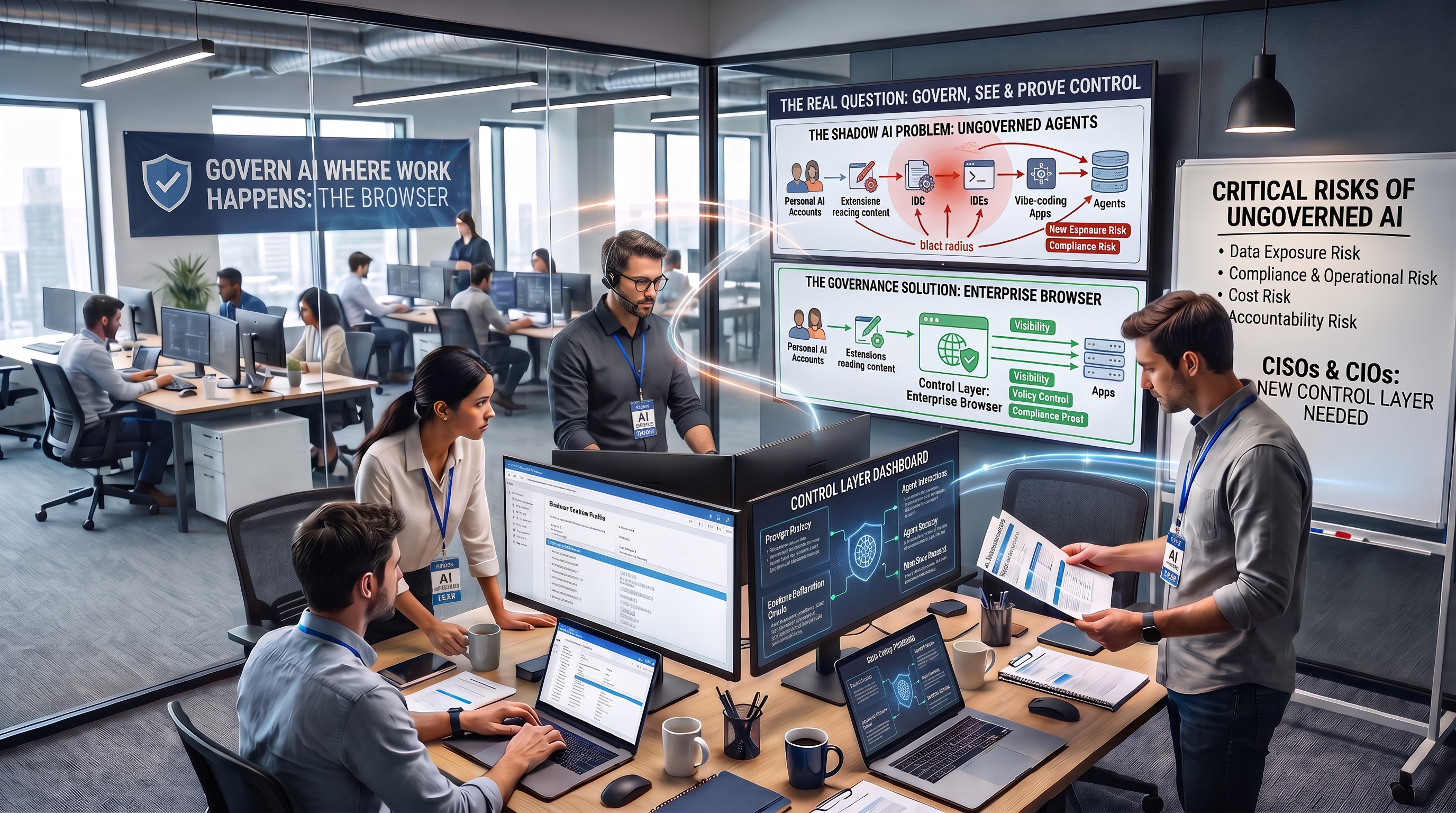
AI is no longer arriving through one approved tool, one sanctioned provider, or one controlled enterprise rollout.
It is entering through employees, browser-based AI tools, personal accounts, AI extensions, desktop applications, coding assistants, AI-native browsers, MCP integrations, citizen-built apps, and autonomous agents.
That changes the security problem completely.
Agents are now joining the workforce alongside people, and security teams need a new playbook to say yes to AI without losing control.
For CISOs ad CIOs, this is not a future concern.
It is already happening.
Employees are signing into personal AI accounts. They are installing AI extensions. The yare building their own apps with vibe-coding tools. Business leaders are pushing AI into every function. Meanwhile, agents are being built, bought, and deployed without normal on-boarding, policy awareness, compliance understanding, or auditability. The result is a second workforce operating inside the enterprise with no registry, no policy, and no audit trail.
That is not innovation risk.
That is operational exposure.
Traditional controls were not built for this
Legacy DLP, endpoint protection, and network monitoring were designed for a world where applications did not read content, observe behavior, retain context, connect to internal systems, or take autonomous action. Agents do all of these things, across every surface, at scale.
This is why relying on existing controls alone is dangerous.
Network tools see traffic, but not the full endpoint context. EDR sees the endpoint, but not the prompt or intent inside the browser. Identity tools see which credential touched a resource, but not why. CASB and SaaS tools see service-side actions, but not the full chain of prompt, tool call, response,and resulting data movement.
This delay matters.
In an agentic world, agents do not wait. They act, compound, and by the time fragmented security tools catch up, the blast radius may already be set.
For a CISO, that means incidents may be discovered after the fact, with incomplete evidence and unclear accountability.
For a CIO, it means AI adoption may accelerate without cost control, user visibility, or confidence that the digital workplace is operating safely.
For both, t means the organization may be scaling AI faster than it can govern it.
Ungoverned AI has real consequences
The danger is not that employees use AI.
The danger is that they use it without visibility, boundaries, identity, or control.
Ungoverned agents can leak sensitive data, execute destructive actions, or access resources they were never meant to touch. Unlike a human mistake, an agent can repeat the same mistake thousands of times before anyone notices.
Overly permissive agents become a liability when prompt injection, compromised MCP servers, or unexpected instructions cause them to act in ways no one anticipated.
Shadow AI creates another risk: employees using personal AI accounts, un-vetted extensions, and consumer-grade tools move corporate data into environments the organization cannot see or govern. What looks like productivity may become data exposure waiting to surface.
And there is a financial dimension.
Without visibility into which agents are running, which models they use, and how often, AI spend can scale faster than anyone can track. By the time the invoice arrives, the damage is already done.
The AI attack surface now includes these security entry points that must be covered:
AI browser extensions, emerging AI browsers, autonomous agents, citizen-built apps, desktop AI applications, AI-powered IDEs, MCP integrations, AI connectors, and network-level AI traffic.
Most organizations have partial coverage at best.
That is not enough.
A complete AI governance model must answer questions such as:
- Can you distinguish corporate AI usage from personal AI accounts?
- Can you see what data employees send to AI tools?
- Can you enforce policy before prompt content leaves the browser?
- Can you inventory AI extensions in real time?
- Can you assign identities and scoped permissions to agents?
- Can you audit every agent action?
- Can you govern MCP integrations and AI connectors?
- Can you track AI activity across roaming users and off-network devices?
If the answer is no, then the organization does not have AI governance.
It has AI activity.
Those are not the same.
What real enterprise AI control looks like
Mature AI security is not about blocking everything.
It is about enabling AI with control.
That requires full inventory of every agent, continuous monitoring of agent behavior, detection of un-vetted agents, visibility into multi-step agentic tasks, agent identitied with scoped permissions, MCP governance, human accountability, full audit trails, threat detection, data protection, model choice, cost visibility, and app publishing governance.
It also requires real-time protection against prompt injection, jailbreaks, agent drift, malicious URLs, malicious MCPs, data leakage, and unwanted content. Data protection must combine deterministic DLP with contextual evaluation, while keeping corporate data out of personal AI accounts and ungoverned environments.
This is where the next gen advanced enterprise browser becomes strategically important.
Instead of trying to stitch together visibility across seven or more point solutions, the next gen advanced enterprise browser gives organizations a control layer at the point where people, agents, applications, data, prompts, and workflows intersect.
That matters because AI governance cannot depend on after-the-fact reconstruction.
- It must happen in real time.
- Inside the work.
- Before data moves.
- Before agents act too broadly.
- Before shadow AI becomes a compliance event.
- Before cost overruns reach the CFO.
- Before a CISO has to explain why the organization could not see what its own AI agents were doing.
The leadership decision
AI security is not about saying no.
It is about building the controls that allow the organization to say yes with confidence. The organizations that win with AI are not the ones that blocked it the longest, but the ones that built controls to govern it, deploy it safely, and scale it with confidence.
For CISOs and CIOs, the deadline is NOW.
- Not after AI is fully embedded.
- Not after agents have multiplied.
- Not after shadow apps are already running business processes.
- Not after the first data exposure.
- Not after the board asks for proof.
If your organization cannot inventory AI usage, govern agents, control prompts, protect data, audit actions, manage MCP integrations, and track AI cost, then AI is already moving faster than your governance model.
The next gen advanced enterprise browser gives security and IT a practical way to regain control where AI work actually happens.
Do not wait until your AI risk becomes an incident report, audit finding, or board-level explanation.
Assess your AI governance gaps now.
At CySecPros we help you evaluate how the next gen advanced enterprise browser can give your organization visibility, control, and confidence before agentic AI scales beyond your current security architecture.
Strengthen your session and control framework - contact CySecPros for a confidential discussion.
.svg)